
Process & Reality
Which Japanese Businesses Actually Change Hands: A Sector Map for Buyers
The sectors where Japanese succession deals actually close, why the industries with the most successor-less owners are not the ones that transfer most often, and how licensing, channel, and workforce age should shape your target list.

Key takeaways
- Most 'top sectors for succession' lists blend three different questions — where owners lack successors, where deals actually close, and where a foreign buyer should look. The answers diverge sharply.
- Manufacturing has the lowest successor-absence rate of any major sector (42.4% in Teikoku Databank's 2025 survey) yet is the largest single category of completed third-party transfers at government succession centers (19.5%). It over-transacts because policy support and consolidator demand concentrated there.
- Construction is the inverse: the highest absence rate (57.3%), the most successor-shortage bankruptcies, and only 12.2% of center closings. Licensing and qualified-personnel rules throttle transfer, which is why supply keeps piling up.
- Your sourcing channel silently selects your sector. Platforms skew toward consumer services, retail, and food; succession centers and intermediaries skew toward manufacturing, wholesale, and construction.
- In licensed sectors — construction, pharmacy, care, trucking — the binding constraint is rarely the paperwork. It is whether you can retain or hire the specific qualified people the licence depends on.
Why most "top sectors" lists are three lists wearing one label
Every few months someone publishes a ranking of the Japanese industries most likely to be handed to a successor. The rankings are usually roughly right and almost always analytically useless, because they quietly blend three different questions:
- Where are the successor-less owners? A demographic question.
- Where do transfers actually complete? A market question.
- Where should you look? A strategy question.
These produce different answers. In the two sectors that matter most to serious buyers, they produce nearly opposite answers. Getting the distinction straight is the difference between a target list built on where the problem is and a target list built on where the problem is solvable.
Ranking one: where the successors are missing
Teikoku Databank's annual successor survey is the closest thing Japan has to a census of the gap. Its 2025 edition, covering roughly 270,000 companies over the two years to October 2025, found 138,000 firms with no successor identified — a national absence rate of 50.1%, down 2.0 points and the seventh consecutive year of improvement.
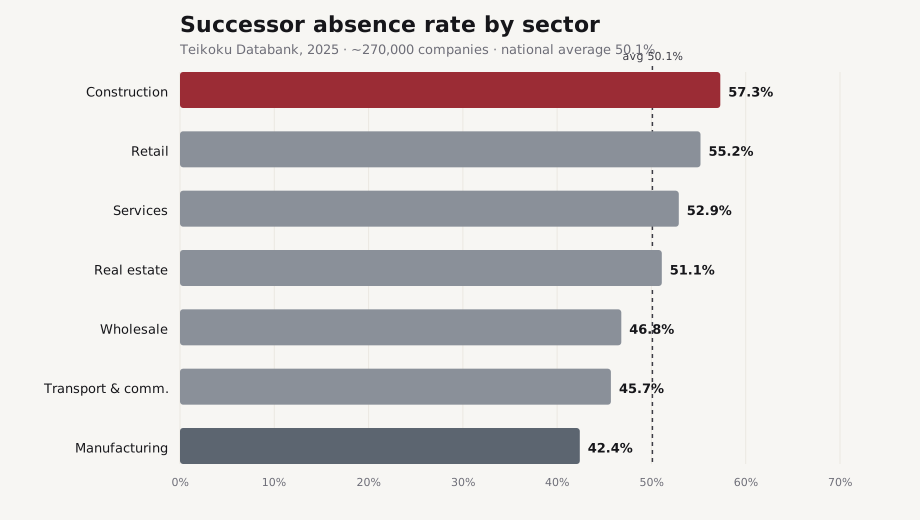
The sector distribution is where it gets interesting, particularly read against what actually closes:
| Sector | Successor-less, 2025 (TDB) | Share of completed center transfers, FY2024 |
|---|---|---|
| Construction | 57.3% | 12.2% |
| Retail | 55.2% | 18.1% (with wholesale) |
| Services | 52.9% | 27.3% (incl. "other") |
| Real estate | 51.1% | — |
| Wholesale | 46.8% | (see retail) |
| Transport & communications | 45.7% | 3.0% |
| Manufacturing | 42.4% | 19.5% |
| Accommodation & food service | (within services/retail) | 14.6% |
| Medical & welfare | — | 5.3% |
| National average | 50.1% | — |
The two columns come from different taxonomies and are not strictly comparable line by line — the centers group wholesale with retail and bundle a large "other" into services. Treat the table as a shape, not a spreadsheet. The shape is the point.
A few details worth carrying: within construction, specialty trade contractors sit at 61.3% and equipment installers at 58.0%. The single worst sub-sector nationally is automobile and bicycle retail at 62.3%. Geography matters as much as industry — Akita prefecture runs at 73.7% while Mie sits at 33.9%.
Ranking two: where transfers actually complete
Absence rates measure a stock of unsolved problems. Completed deals measure flow. Three sources triangulate it.
Government succession centers. The prefectural Business Succession and Handover Support Centers completed 2,132 third-party transfers in the year to March 2025, a record. The sector mix is the right-hand column above. Note the size distribution: 36.1% of transferring companies had revenue under ¥30M and 31.9% between ¥30M and ¥100M. Only 5% exceeded ¥500M.
Open platforms. BATONZ closed 753 deals in the year to March 2026, down 6.5% year on year — not from weak demand but from deliberate tightening: stricter user and listing screening, and effectively mandatory advisory support on share transfers. Revenue rose 45.3% on a sharply higher average deal size. As of February 2026 it carried 10,673 live listings against roughly 303,000 registered buyers. Its closed-deal mix runs to roughly a fifth consumer services, a sixth retail and apparel, and a seventh food and beverage. TRANBI, meanwhile, has passed 1,000 cumulative individual-buyer closings at a median price of ¥1.9M — the micro end of the micro end, topped by coworking spaces, e-commerce stores, and websites.
The failures. In the year to March 2026, Teikoku Databank counted 533 successor-shortage bankruptcies, a third straight year above 500. By sector: construction 123, services 97, manufacturing 90. In 45.2% of cases the trigger was the owner's illness or death — not a strategic decision, but the clock running out. Tokyo Shoko Research's parallel count of 461 was the highest since it began tracking in 2013.
That third dataset is the one to sit with. It is the measure of deals that didn't happen.
The inversion that matters
Put the two rankings side by side and the headline is not "manufacturing is big." It is that manufacturing and construction are inverted.
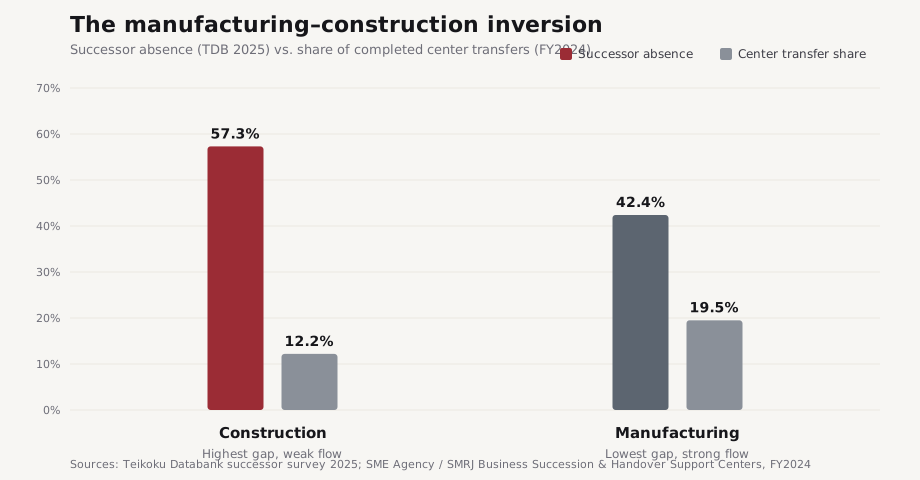
Manufacturing has the lowest successor-absence rate of the eight major sectors, yet supplies the largest single share of completed center transfers. It over-transacts relative to its gap. The reasons are specific and worth understanding, because they are the reasons your deal will be findable: policymakers treated supply-chain fragility in the automotive and industrial base as a systemic risk and concentrated support there; consolidators and regional funds actively hunt technical SMEs; and a machining business with equipment, drawings, certifications, and named customers is legible to a buyer, a bank, and a valuer in a way that a personality-driven service business is not.
Construction is the mirror image. Highest absence rate, most successor-shortage bankruptcies, and barely an eighth of completed center transfers. The supply is enormous and the throughput is poor. Transfers are throttled by licensing and qualified-personnel requirements, by personal guarantees entangled with the owner's home, by public-works evaluation ratings that reset badly if the transfer is handled clumsily, and by a skilled-labour market so tight that the acquired workforce is often the only real asset.
This is the single most useful fact in the data. A high successor-absence rate is not an opportunity signal — it is a friction signal. It marks sectors where owners want out and the market cannot clear. Whether that is your opening or your warning depends entirely on whether you can solve the specific friction causing it.
The ten categories, annotated
Synthesising listing volume, closed-deal share, and observed foreign-buyer outcomes, here is the working target list — ordered roughly by the volume of genuine opportunity, with the constraint that actually decides each one.
| # | Category | Why it ranks | The gate you must clear |
|---|---|---|---|
| 1 | Manufacturing | Highest-quality flow; transferable know-how, equipment, named customers | Workforce age, customer concentration, deferred capex |
| 2 | IT / software / communications | High volume; talent scarcity drives both succession and strategic deals | Valuation variance, real competition, key-person risk |
| 3 | Wholesale & retail | Large small-firm population under e-commerce pressure | Working capital, thin margins, operational intensity |
| 4 | Services (general B2B) | Broad category, many aging owners | Quality dispersion; often the owner is the asset |
| 5 | Accommodation & food service | Very high listing volume, low entry barriers | Labour intensity, lease terms, seasonality |
| 6 | Construction | Largest unsolved gap; strong domestic demand | Licence succession and qualified personnel |
| 7 | Real estate services | Aging agency and property-management owners | Licensed agent requirement; relationship-bound revenue |
| 8 | Medical, welfare & pharmacy | Aging society; heavy pharmacy roll-up activity | Administered pricing; regulatory and licensing load |
| 9 | Transport & logistics | Driver shortage, 2024 overtime rules, aging owners | Operating licence, price pass-through, thin margins |
| 10 | Lifestyle, beauty & personal services | Enormous volume of very small deals | Sub-scale economics; rarely institutional-grade |
Tier one: where quality meets volume
Manufacturing deserves its position, but not for the reason usually given. The appeal is not craftsmanship romance — it is that a precision metalworking, plastics, or industrial-component business gives you something to underwrite. Restated net assets mean something because the equipment exists. Goodwill means something because the customer list is contractual. Under the prevailing pricing convention this lands in the low single-digit multiples of normalized owner earnings, as covered in valuation reality. Diligence should concentrate on three things: the age profile of the skilled workforce, whether one customer exceeds a third of revenue, and how many years of maintenance and tooling investment the retiring owner quietly postponed.
IT and software is the volume outlier, and the sector where your Western instincts are most nearly correct — which is precisely the problem. Competition is real, strategic buyers are paying for capability rather than assets, and multiples scatter widely. A system-development shop whose value is thirty engineers who like their founder is a retention problem wearing a balance sheet.
Tier two: high volume, high operating load
Wholesale and retail, general services, accommodation and food, and lifestyle and beauty account for most of what you will see if you spend an evening on a platform. That visibility is a channel artifact, not a market truth. These are genuine businesses and they genuinely transfer, but they are working-capital-hungry, labour-intensive, and locally competitive. The honest question for a foreign buyer is not whether such a business is cheap. It is whether you intend to run a restaurant or a salon chain personally, in Japanese, six days a week. If the answer is no, listing volume is irrelevant.
Tier three: big gap, hard gates
Construction, medical and welfare, transport and logistics, real estate. Every one of these has a large and growing supply of successor-less owners. Every one is gated.
The gates are not equivalent, and the distinction matters. Construction's gate is administrative and solvable — the licence carries over cleanly if you plan for it, and the underlying demand is strong enough that domestic roll-ups are actively forming. Pharmacy and care sit behind an economic gate that planning cannot fix: revenue is set by biennial government fee revisions, not by you. The 2024 care revision cut base compensation for home-visit providers and the sector recorded 176 operator bankruptcies in 2025, a second consecutive record, with home-visit care alone at 91 and over 80% of failures at operators with fewer than ten employees. Pharmacy bankruptcies hit a record 38 while the largest chains consolidated aggressively — Ain Holdings absorbing Craft, Nihon Chouzai taken private. When small operators' margins collapse and large ones' improve, you are looking at a scale industry, and sub-scale entry is not a discount.
Logistics sits between the two. Road freight bankruptcies ran 321 in the year to March 2026 — down from 351 but still the fourth-highest on record — as the 2024 overtime rules, driver scarcity, and fuel costs compressed a sector with the weakest price pass-through in the economy. There is a real consolidation thesis here. It is an operator's thesis, not a first-timer's.
Licensing is the real sector filter
For a foreign buyer, licensing decides more of your target list than sector attractiveness does. Construction is the instructive case because the rules changed recently and in your favour.
Before October 2020, transferring a construction business meant surrendering the licence and reapplying, leaving a blackout period during which the company could not take on qualifying work. The amended Construction Business Act created a prior-approval route (Articles 17-2 and 17-3): obtain the licensing authority's approval before the effective date and the acquirer inherits the licence — same number — along with the public-works evaluation rating that determines eligibility for government tenders. Three practical points:
- Approval must precede the closing date and cannot be granted retroactively. Filing windows and processing times vary by authority; budget one to three months, longer for minister-level licences, and make regulatory approval a condition precedent in the agreement.
- You must independently satisfy the qualification requirements — a qualified full-time management officer and a qualified site technician per office (renamed in the December 2024 amendments). This is the actual constraint. The paperwork is a formality; finding a licensed technician willing to join a foreign-owned contractor is not.
- A share transfer sidesteps the whole regime. The company continues as a legal person, so the licence never moves. You file officer changes instead. This is a strong argument for share transfers in every licensed sector — and it means you inherit the company's full history, which is exactly why diligence tightens.
The same logic generalises. In pharmacy, care, trucking, and real estate brokerage, the binding constraint is nearly always a named qualified human being whose continued presence the licence depends on. Identify that person during diligence and ask what happens if they retire the month you close.
What sector choice does to price and financing
Sector selection quietly sets three things beyond price.
Which channel you must use. Manufacturing, wholesale, and construction flow through zeirishi, regional banks, and intermediaries. Consumer services, retail, and food flow through platforms. Choosing a sector and then choosing the wrong channel is the most common way foreign buyers spend a year seeing nothing worth buying. The platform and ecosystem landscape maps which channel carries what.
Whether a bank will lend. Asset-backed sectors with legible collateral — manufacturing, logistics, property-holding businesses — give a regional bank something to secure against. That matters disproportionately for a buyer without Japanese credit history.
What your first year looks like. In manufacturing you inherit a process and can learn it. In personal services you inherit a personality and cannot. Since 45.2% of successor-shortage failures are triggered by the owner's illness or death, some processes arrive without their author. Sector determines how survivable that is.
A screen you can actually use
Before adding a sector to your list, answer six questions honestly:
- Is revenue set by the market or by the government? Administered-price sectors are scale games. Do not enter them sub-scale.
- What licence does this need, and which named person holds it? If that person is the retiring owner, you are buying a countdown.
- Is the workforce younger than the owner? In construction and manufacturing this is frequently no, and it silently reprices the deal.
- Which channel carries this sector, and can I reach it? If the honest answer is "platforms only," you have chosen a consumer-services thesis by accident.
- Would a Japanese bank lend against this? Their answer is free diligence on collateral quality.
- Can I run it in Japanese in year one, or do I need inherited management? Only a minority of small Japanese SMEs have a functioning second layer. Confirm it exists before you rely on it.
The market-level conclusion is less exciting than the rankings suggest and more useful. Japan's succession supply is genuinely vast — 5,115 M&A deals nationally in 2025, a record, with domestic transactions up 10.4% — and the sectors where that supply is thickest are mostly thick because transfer is hard there. Your edge is not finding the sector with the most retiring owners. It is picking a sector whose specific friction you are unusually equipped to absorb, and then reaching it through the channel that sector actually uses.
Where to go next
- Start with the end-to-end process if you haven't: The Complete Foreign Buyer's Guide
- Understand what these businesses trade for: Valuation Reality in Japanese Succession Deals
- Match your sector to a sourcing channel: The Platform and Ecosystem Landscape
- Learn the owner's side of the table: How Japanese Owners Decide
When you've narrowed to a sector and a region, start a qualified conversation — that is the point at which a local counterpart becomes useful rather than premature.
Frequently asked questions
- What kinds of Japanese businesses are most commonly sold through succession M&A?
- Across Japan's government Business Succession and Handover Support Centers, which completed a record 2,132 third-party transfers in the year to March 2025, the largest categories of transferring companies were services and other (27.3%), manufacturing (19.5%), wholesale and retail (18.1%), accommodation and food service (14.6%), and construction (12.2%), with medical and welfare at 5.3% and transport at 3.0%. Online platforms show a different mix skewed toward consumer services, retail, and restaurants, because their deal sizes are far smaller.
- Which Japanese industry has the highest successor absence rate?
- Construction. Teikoku Databank's 2025 national survey of roughly 270,000 companies put the construction successor-absence rate at 57.3%, the highest of the eight major sectors, against a national average of 50.1%. Within construction, specialty trade contractors reached 61.3%. Manufacturing was the lowest of the eight at 42.4%. This is the opposite of what most sector rankings imply, because high absence rates reflect blocked transfers rather than active ones.
- What is the best sector for a foreign buyer acquiring a Japanese business?
- Niche manufacturing is the most consistently attractive category for serious buyers: technical know-how, installed equipment, long-standing customer relationships, transferable process knowledge, and pricing conventions that land in the low single-digit multiples of normalized owner earnings. It is not the easiest sector — equipment condition, customer concentration, and the age of the skilled workforce are real risks — but it is where deal quality and deal volume overlap most reliably.
- Can a foreign buyer acquire a Japanese construction company?
- Yes, with planning. Since the amended Construction Business Act took effect in October 2020, a construction licence can be carried over through a business transfer, merger, or split by obtaining prior approval from the licensing authority, preserving both the licence number and the public-works evaluation rating. Approval must be granted before the effective date, cannot be applied retroactively, and typically requires one to three months. The acquirer must independently satisfy the management and site-technician qualification requirements, which is usually the harder test. A share transfer avoids licence succession entirely because the company itself continues.
- Are Japanese pharmacies and care businesses good acquisition targets?
- They generate high deal volume but poor risk-adjusted entry for most first-time foreign buyers. Both are administered-price industries: revenue is set by biennial government fee revisions rather than by the market. Pharmacy bankruptcies hit a record 38 in 2025 and care-operator bankruptcies a record 176, concentrated overwhelmingly in operators with fewer than ten staff. Domestic consolidators with scale advantages are the natural buyers, and they bid accordingly.
Related reading

The Complete Foreign Buyer's Guide to Japanese SME Succession
How Japanese business succession (jigyo shokei) actually works for foreign buyers: the market reality, the process from thesis to close, realistic timelines, and the mistakes that end deals before they begin.
Read the guide
Valuation Reality in Japanese Succession Deals
What Japanese SMEs actually sell for in succession deals: the net-asset-plus-goodwill convention, realistic earnings multiples, why reported profit misleads, and how deal structure changes the real price.
Read the guide
The Platform & Ecosystem Landscape: BATONZ, TRANBI, Government Centers, and Beyond
A clear map of Japan's succession M&A ecosystem for foreign buyers: what BATONZ and TRANBI are actually good for, how government succession centers work, where intermediaries and banks fit, and how to use each channel intelligently and ethically.
Read the guideExploring Japanese succession seriously?
If you're a qualified buyer or an advisor with aligned interests, we read every inquiry personally and reply within two business days.
Start a qualified conversation